
Private Surf Coaching vs Group Surf Lessons: What’s the Real Difference?
If you are trying to decide between a group surf lesson and private surf coaching, you are not alone. In fact, it is one of the most common questions beginner and intermediate surfers ask before booking their first session.
Both options can teach you to surf, but they are not the same experience. Because of that, understanding group surf lessons vs private coaching matters more than most people realise before they actually try both.
However, the difference is not just about price. It is about how fast you progress, how safe you feel in the water, and whether you truly understand what you are doing.
Sand vs Attention: What Actually Changes in a Group
Before comparing formats, it helps to understand what changes physically when a coach is responsible for more people. For example, a single instructor watching 8 or 10 students in the water simply cannot see everything. As a result, boards drift, waves come in sets, and attention gets split in every direction at once.
Generally speaking, industry guidelines consider a maximum of around 6 students per instructor to be the point where individual correction time starts to matter. Beyond that, an instructor stops teaching individuals and starts managing a crowd.
That said, this is not a criticism of group lessons or the instructors who run them. Many are highly capable and genuinely care about their students. However, the limitation is structural, not personal. One person cannot give ten people the same depth of attention they could give one.
What Students Tell Me After Trying Group Lessons First
Over the years, many of my private students have come to me after group lessons elsewhere. Because of that, I hear the same stories repeatedly. For instance, a board sometimes catches someone in the head because nobody was watching that side of the group. In other cases, a student never quite understands why they keep falling, because the correction they needed was given to someone else that day. Meanwhile, someone with a fear of deeper water spends the whole session anxious, because the instructor is focused on getting waves for everyone rather than checking in on one person.
None of this means group lessons are unsafe by design. Instead, it means that in a group, intensive surf training simply is not possible. The coach manages logistics, not technique.
The Best Way to Learn Surfing: Why Private Surf Coaching Wins on Time
One of the clearest differences between private and group students is speed of progression. What a student typically learns over three or four group sessions, a focused private session can often cover in a single day. This is not because private coaching is magic. Rather, it happens because every minute is spent on exactly what that person needs, instead of what the group as a whole needs.
If you want to know exactly what that focused approach looks like session by session, check out our guide on How to Progress Faster in Surfing.
This is also where a real surf coach differs from a surf instructor. While an instructor teaches the basics of standing up and catching whitewater, a coach studies how to break down technique, how to read a student’s specific blocks, and how to adapt an entire session in real time.
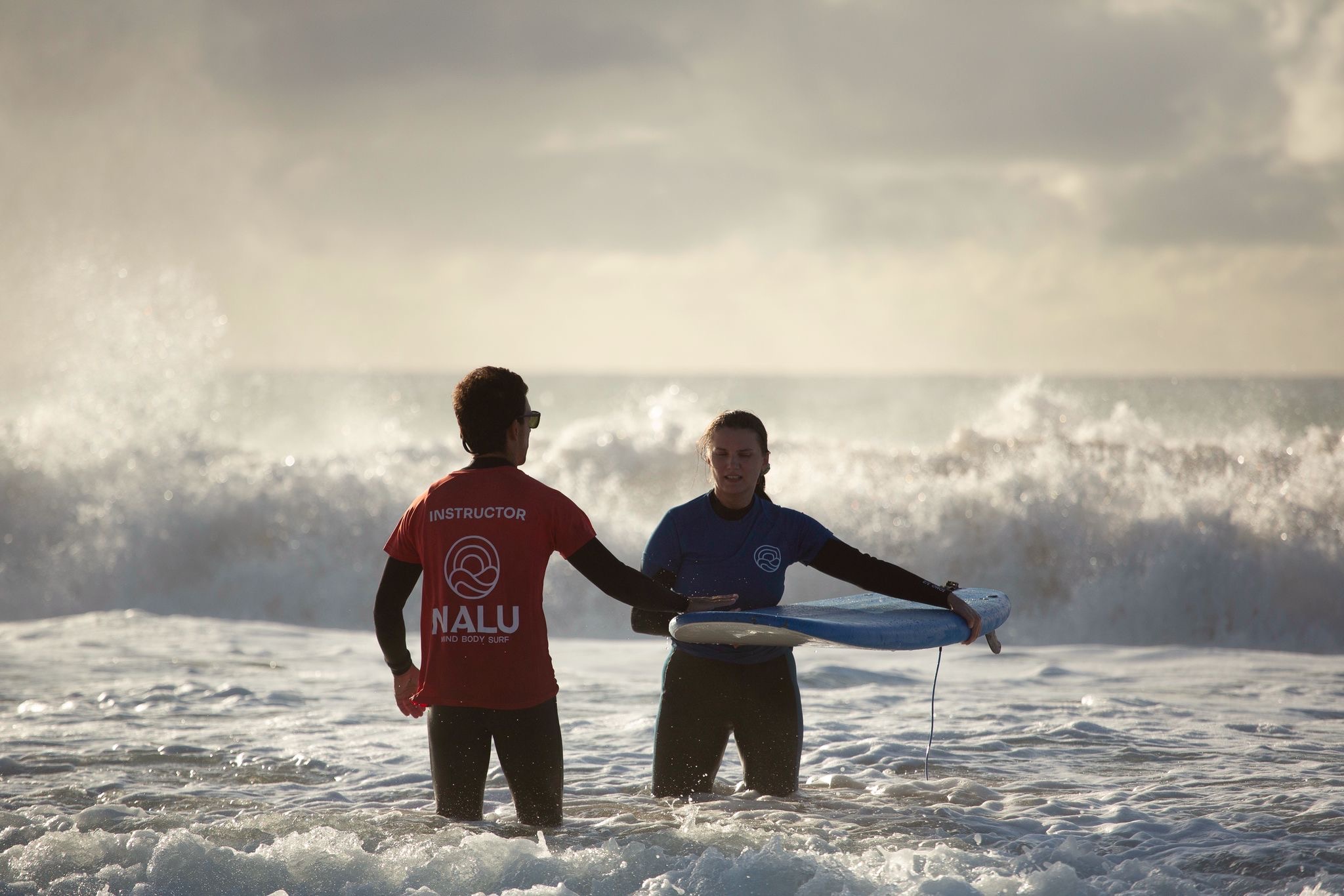
Safety Is Not Just a Talking Point in Private Surf Coaching
Safety in the ocean is not only about rip currents and reading conditions, although those matter enormously. It is also about how closely you are being watched. In a private session, for example, a coach can react instantly if something feels wrong: a wave breaking differently than expected, a moment of hesitation before a take-off, or a student drifting slightly too close to a rock or another surfer.
For someone with a fear of deeper water, this level of attention is not a luxury. On the contrary, it is often the single factor that determines whether they ever feel comfortable in the ocean at all.
Group Surf Camps Have Their Place. It Is Not the Same Place.
Group surf camps and kids’ camps serve a real purpose: a fun, social introduction to the ocean, often for children or casual holidaymakers who simply want to try something new. There is nothing wrong with that experience for what it is.
However, for an adult who genuinely wants to learn to surf properly and become an independent, confident surfer, that format has clear limits. Real progression requires structured, focused, individually tailored coaching, not a rotating group experience designed for entertainment rather than skill development.
The Cost Question: Is Private Coaching Worth It?
At first glance, group lessons often seem like the more affordable option. However, the real comparison is not about price per session. It is about price per result.
Because a group format spreads attention across multiple people, progress tends to be slower. As a result, a student might need several group sessions to reach a level of skill that a single, focused private session could achieve. When you factor in the number of sessions actually required to see real improvement, private coaching frequently works out to be a more efficient use of both time and money, not necessarily a more expensive one.
This becomes even more relevant for surfers on a short trip. If you only have a few days in the water, private coaching maximises every single session, instead of hoping the group dynamic works in your favour that day.
Which One Is Right for You: Private Surf Coaching or Group lessons?
If you want to try surfing casually, meet people and enjoy a fun day at the beach, a group lesson can absolutely deliver that. But if your goal is to genuinely learn to surf, understand the ocean and progress quickly and safely, private coaching offers something a group format structurally cannot: complete, undivided attention.
If you want to see exactly what that difference feels like, you can read more about it here.