
How to Choose the Right Surf Retreat for Your Level
Not all surf retreats are built the same. Picking the wrong one can turn an exciting trip into a frustrating week. Knowing how to choose the right surf retreat starts with three honest questions. What’s your real level? Who’s actually coaching you? And how much attention will you get? If you’d rather skip the research, take a look at our Surf Retreats. You can book directly with a small, personally-run team.
Start with an Honest Self-Assessment
The single biggest mistake surfers make when booking a retreat is overestimating their own level. In fact, it’s an easy trap. You might surf confidently on your local beach break. But a different coastline, with different sand banks, currents or crowd dynamics, can be a different story entirely.
Before booking, ask yourself a few direct questions. Can you paddle out through whitewater on your own, without help? Can you read a set coming and position yourself accordingly? Do you know how to handle a rip current if you get caught in one? If the honest answer to any of these is “not really,” a surf retreat for intermediate surfers, or below, is the better fit for you right now.
This matters because a retreat built for your actual level, not your ideal level, is where real progress happens. Trying to keep up in an advanced surf coaching camp you’re not ready for usually backfires. It often means less time in good waves, more fear, and slower learning overall.
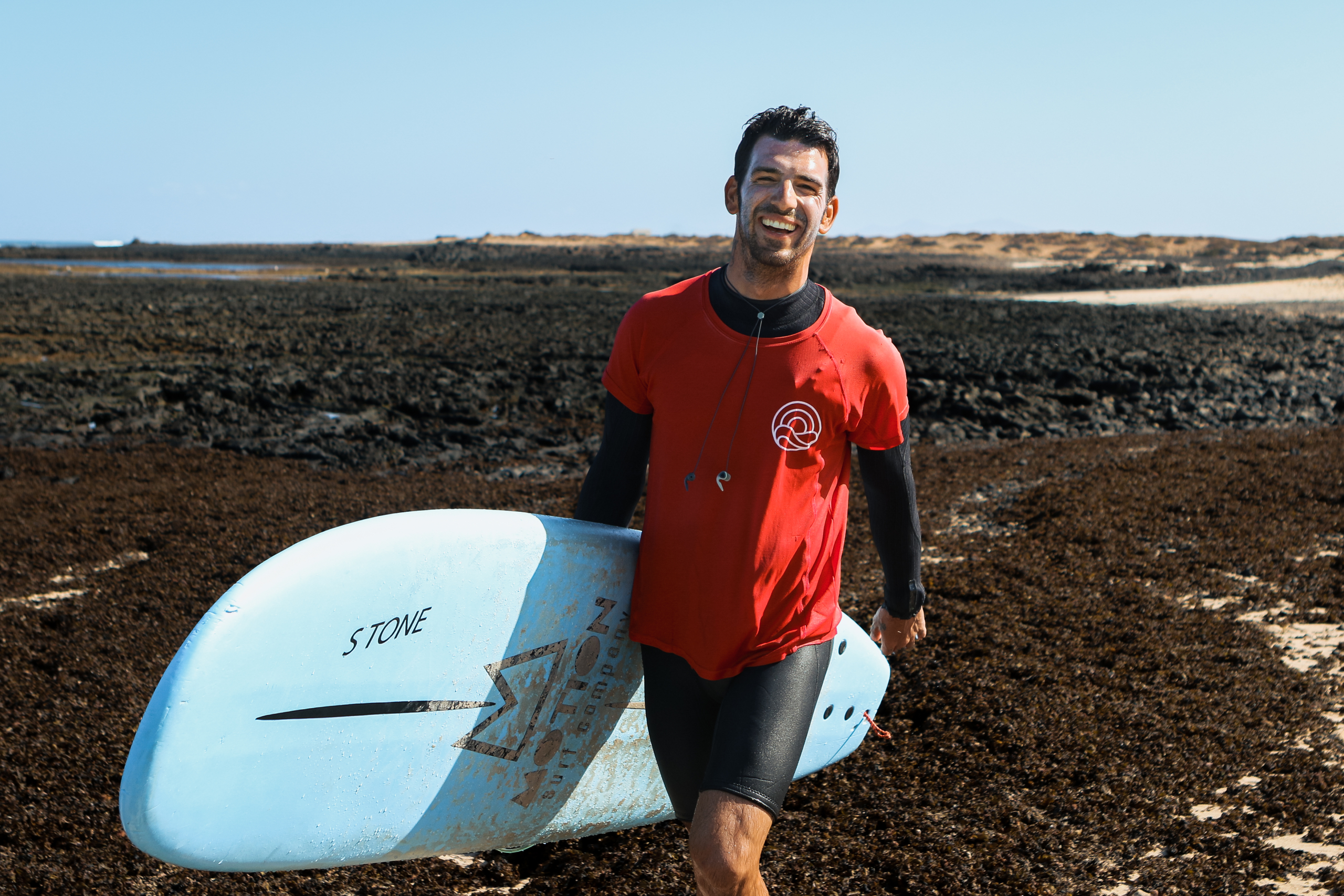
Check the Coach’s Certifications
This is the part most surfers skip entirely, and it shouldn’t be. Before booking, ask directly: is the coach ISA certified, or certified by the national federation (FES in Spain, for example)?
The International Surfing Association (ISA) is recognised by the International Olympic Committee and sets the global standard for surf coaching and instructing. In Spain, the equivalent is the Federación Española de Surf (FES), which regulates official surf instructor qualifications nationally. A legitimate coach should be able to tell you their certification level without hesitating, and in most cases, you can verify it directly through these organisations.
This isn’t about bureaucracy for its own sake. Certified coaches are trained specifically in water safety, rescue response and how to read conditions properly, on top of teaching technique. That difference matters most exactly when something unexpected happens in the water.
Understand the Student-to-Instructor Ratio
Group size is one of the clearest indicators of safe surf camp criteria, and one of the easiest to ask about before booking. As a rule of thumb, once a single coach is responsible for more than 6 students in the water, individual attention drops sharply, and so does safety margin.
A smaller ratio means more correction, faster feedback, and a coach who can actually react if something goes wrong with one specific student, rather than managing the group as a whole. If a retreat can’t tell you their typical group size upfront, that’s usually a sign worth paying attention to.
What a Well-Structured Retreat Actually Looks Like
Beyond level, certifications and ratio, a good retreat follows a clear daily rhythm: morning condition checks, a coached water session with real purpose, theory to understand what you just did, and time to actually rest and absorb it. If you want to see what that structure looks like day by day, our guide on what to expect from a surf retreat walks through a full week in detail.
Final Thoughts
Choosing the right retreat isn’t about finding the fanciest accommodation or the flashiest marketing photos. It comes down to three practical checks. Your honest level, the coach’s real certifications, and how many people you’ll be sharing that coach with. Get those three right, and everything else tends to fall into place.
If you’re still not sure which format fits you best, our comparison between private coaching and group lessons can help. It breaks down exactly how attention and group size affect your progress. And if you’d like personal guidance choosing the right retreat for your level, get in touch. Let’s figure it out together.